
Market Insights · Published 2026-09-14
Men's vs Women's Jewelry Market: Which Should Your Brand Enter First?
By DinHuey JewelryWomen's jewelry represents the larger revenue pool in the market reports reviewed for this guide. That does not automatically make it the best first market for every new brand. A focused men's or gender-inclusive chain collection may be a better starting point for a brand with streetwear customers, while everyday earrings and necklaces may fit a brand that already reaches women through fashion or gifting channels.
The decision should connect market context with your audience, product capability and available cash. This guide combines published research with representative product ideas and a practical entry framework. It is written for independent brands, especially those targeting the United States and other English-speaking markets. Research was checked on September 14, 2026. DinHuey is a jewelry supplier; the recommendations below are commercial planning advice, not an independent survey or a promise of sales.
What the market reports say—and what they do not
| Research source | Market and year | Published estimate | How to use it |
|---|---|---|---|
| Grand View Research | Global jewelry, 2025 | USD 381.5 billion total; women represented 71.9% of revenue | Broad context for the scale of women's jewelry |
| Grand View Research | U.S. jewelry, 2025 | USD 78.40 billion total; women represented 70.7% | More relevant context for a U.S.-focused brand |
| Fortune Business Insights | Global jewelry, 2026 projection | USD 254.13 billion total; women's share projected at 63.73% | A separate provider's outlook, not directly interchangeable with the rows above |
Sources: Grand View Research global jewelry report, Grand View Research U.S. jewelry report and Fortune Business Insights jewelry report.
These are research-company estimates, not government census totals. Their totals differ materially, and the table also contains different reference years. We have not reconciled the providers' underlying datasets and definitions, so we do not average their estimates or use one provider's share with another provider's market value. The defensible common conclusion is that women account for the larger reported revenue share—not that a precise market size is universally agreed.
Do not calculate men's sales simply as 100% minus the women's share: the Grand View Research segmentation also lists children. Nor should end-user categories be treated as the gender of the person paying. Someone purchasing a gift for a woman contributes to a women's product market regardless of the purchaser's gender. Revenue share also does not measure customer count, unit sales, search volume or ease of acquiring customers.
Men's jewelry is not one single opportunity
Separate fashion chains, personalized pendants and wedding bands before making a market-entry decision. For example, Grand View Research estimates the U.S. men's metal wedding band market at USD 1.17 billion in 2025, with a projected 4.1% compound annual growth rate from 2026 to 2033. That is a wedding-band category estimate; it must not be described as the size or growth rate of men's chains or all men's jewelry. Source: U.S. men's metal wedding bands report.
A bridal business requires its own approach to sizing, purchase timing, service and customer reassurance. A fashion-chain business instead needs to explain visual scale, length, finish and styling. Grouping both under a single men's label hides the differences that matter when choosing samples and building product pages.
The same principle applies to women's jewelry. Everyday huggie earrings, personalized gifts and high-value bridal rings can involve very different buying journeys. Start with a specific need inside a market, not a catalog intended to serve everyone in it.
Representative men's and gender-inclusive product ideas
The following are recognizable product categories to evaluate, not a measured bestseller ranking. Suggested specifications are starting points for discussion; material, size, construction and availability need confirmation for each project. These styles are not restricted to one gender.
| Product name | Possible role in a collection | Important development question |
|---|---|---|
| Cuban Link Chain Necklace | Main statement or streetwear piece | Do the links sit comfortably, and does the clasp suit the weight? |
| Rope Chain Necklace | Textured everyday or layering option | Does the complete end fitting pass through the intended pendant bail? |
| Signet Ring | Personal identity or engraving concept | How many sizes can the launch support and replenish? |
| ID Plate Bracelet | Personalization and gifting | Is the engraving area readable at the final scale? |
| Custom Number Pendant | A distinctive personal or team-inspired design | Are the number, proportions and chain pairing clear? |
| Metal Wedding Band | A dedicated bridal offer | Can the brand support accurate sizing and appropriate after-sales service? |
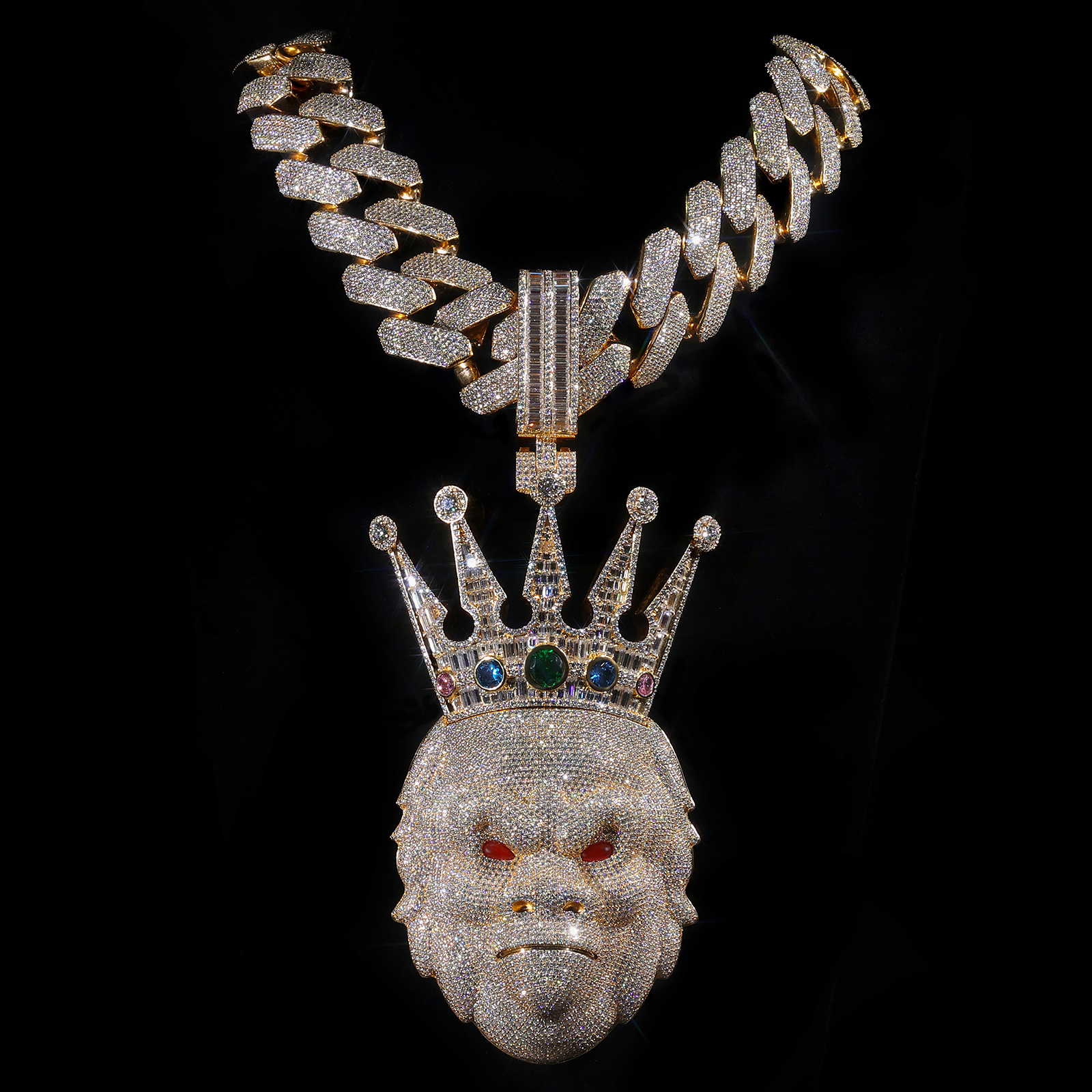
DinHuey product visual: a crown-themed statement pendant with a Cuban-link chain. This illustrates a bold design direction, not a market-leading product or a confirmed stainless steel specification. Metal and stone identity cannot be established from the photograph alone.
For a streetwear-oriented brand, our suggested first test is a clear chain-and-pendant story rather than six unrelated categories. A Cuban chain can provide the signature look, a rope chain can offer a different texture, and a custom pendant can provide a more individual identity. Read our stainless steel Cuban and rope market guide and custom number pendant guide for related planning questions.
Representative women's and gender-inclusive product ideas
For an everyday or gifting-oriented brand, evaluate a coordinated set of products that can be understood individually and together. The opportunity is not simply to offer more designs. It is to make the selection, fit and presentation easier for a particular customer.
| Product name | Possible role in a collection | Important development question |
|---|---|---|
| Huggie Hoop Earrings | Compact everyday earring concept | Are inner diameter, closure and pair weight suitable? |
| Round Stone Stud Earrings | Simple solo purchase or gifting option | Are stone size, setting and backing clearly specified? |
| Initial Pendant Necklace | Personalized gift or self-purchase | Can the brand manage letter availability and dispatch expectations? |
| Layering Chain Necklace | Entry product or companion piece | Do the lengths separate cleanly when worn together? |
| Tennis Bracelet | Stone-set focal piece | Are setting consistency, clasp and wrist fit satisfactory? |
| Stacking Ring | Coordinated styling concept | Does the required size inventory fit the launch budget? |
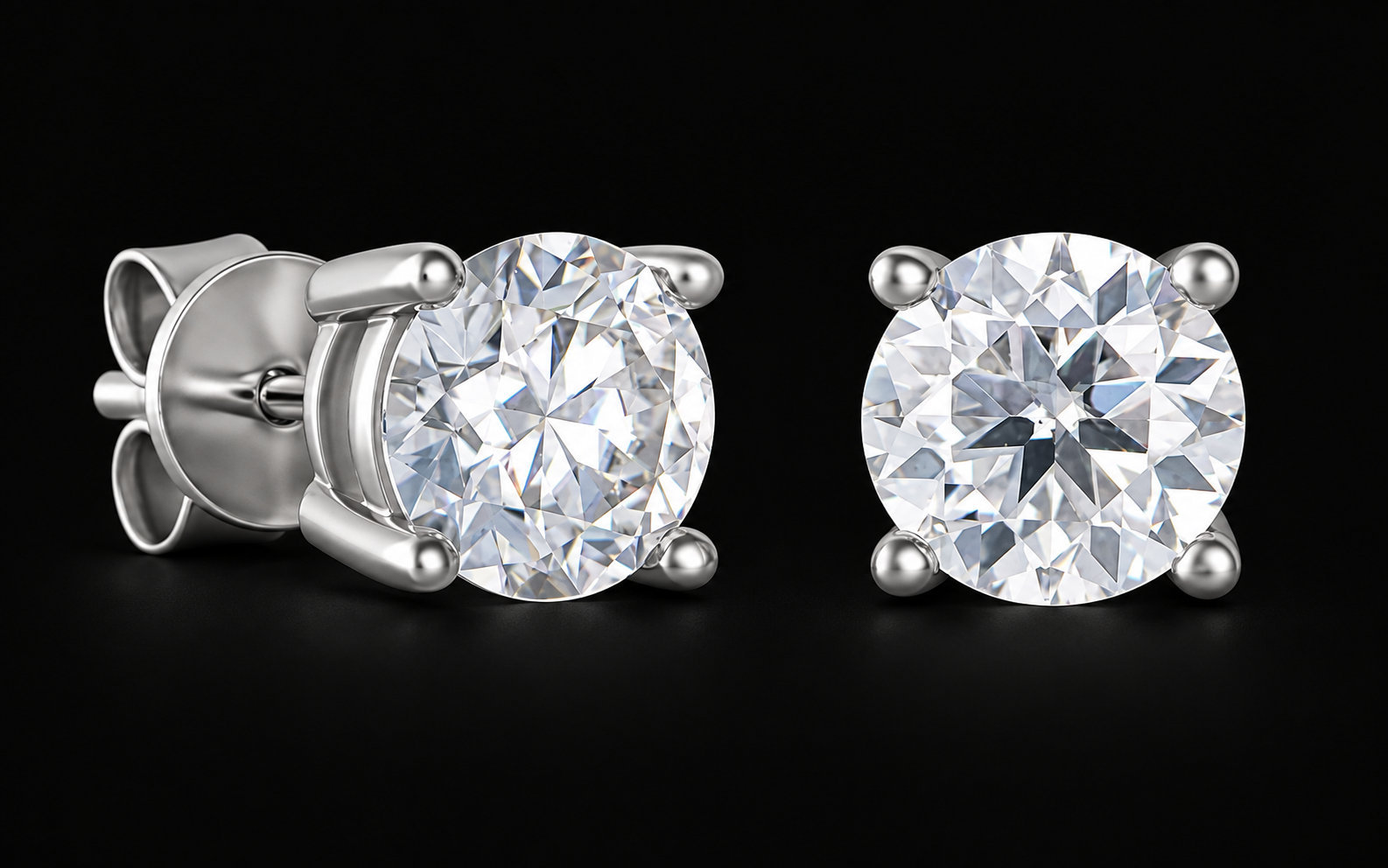
DinHuey website product visual: round stone stud earrings, shown as an example of a compact jewelry category. The display image is not proof of gemstone identity, precious-metal content or market demand. Stud earrings can also serve men's and gender-inclusive collections.
For a brand already selling women's clothing or gifts, our suggested first test is one earring design and one complementary necklace. Add a bracelet or ring when customer requests and unit economics support it. Coordinated presentation can be tested without immediately carrying many ring sizes, multiple stone colors and a large personalization inventory.
Which market should your brand enter first?
Choose the market in which you have the strongest evidence of customer access and product credibility. A larger national category does not guarantee that your small brand can reach it economically. Conversely, a smaller category is not automatically less competitive or more profitable.
| Your starting advantage | Suggested first direction | Why this is a reasonable test |
|---|---|---|
| Existing streetwear audience and strong chain or pendant visuals | Men's-led or gender-inclusive chains and pendants | Builds on an existing style and audience connection |
| Existing women's fashion customers or gift-shop relationships | Everyday earrings and complementary necklaces | Connects jewelry to a customer base you already understand |
| Strong bespoke design process and personalization requests | A focused personalized collection across genders | Organizes the offer around a need rather than a broad demographic |
| Bridal expertise and sizing support | A narrowly defined wedding-band offer | Uses relevant service capability rather than treating bridal as an add-on |
| No established audience and limited cash | Small concept tests before choosing either market | Avoids treating market size as evidence of your own demand |
For a brand with a DinHuey-like emphasis on statement chains and custom pendants, we would first test a men's-led or gender-inclusive capsule. That recommendation follows the visible product direction, not verified sales performance. A brand with stronger access to women buying everyday jewelry should make the opposite choice. Neither recommendation depends on a claim that one gender is inherently easier to sell to.
Compare operational complexity, not stereotypes
Inventory complexity comes from your design choices. A men's signet ring in eight sizes may be harder to stock than a women's earring in one size. A women's necklace in two lengths may be simpler than a chain collection with four widths, three finishes and four lengths. Count the combinations before deciding which market is supposedly easier.
Material selection also crosses gender categories. Brass, sterling silver and stainless steel should be considered against design, target positioning, finishing and the full cost of delivery. Do not describe a metal as suitable only for men or women. Our material selection guide explains the underlying trade-offs.
For each proposed product, write down the target retail price, quoted production cost, finishing, packaging, inbound logistics, applicable duties, fulfillment, payment fees and expected return costs. Include customer-service and content-production effort. The relevant comparison is expected contribution after costs, supported by realistic assumptions—not the largest markup between a factory quote and a competitor's retail price.
Two manageable launch examples
A men's-led chain capsule could contain one Cuban chain and one rope chain, each in one finish and two lengths: four SKUs in total. A custom pendant can remain a separately quoted option while the brand learns which chains customers prefer. This avoids presenting a large personalization range as immediately available stock.
A women's-led everyday capsule could contain one huggie earring and one stud earring in one finish, plus one necklace in two lengths: also four SKUs. Check the earring dimensions and fit carefully, and make it clear whether the price is per pair. These examples are assortment proposals, not minimum-order promises or evidence that four SKUs is universally optimal.
The meaningful comparison is which capsule attracts qualified interest, meets quality expectations and can be replenished within your budget. Keep photography, information quality and promotional exposure reasonably comparable when testing. Do not conclude that an entire market is weak because one poorly explained product page receives little attention.
A first-month plan before expanding the collection
During week one, choose one target country and one price position. Interview a small number of potential customers or retail buyers and document the intended wearing occasion, desired specifications and purchase objections. Treat those conversations as qualitative input rather than a representative demographic survey.
During week two, request comparable sample quotations and reduce the initial assortment. Confirm dimensions, finish, closure, packing and the process for approving a reference sample. Ask for documentation relevant to the exact product and destination market. Do not assume that a report for one design covers every new finish or product.
During week three, prepare the collection page, clear product names and useful supporting content. For an SEO-led launch, answer real questions about chain length, pendant compatibility, earring size or customization. Link that content to the relevant product or inquiry page. Avoid copying near-identical text onto separate men's and women's pages when the underlying product is the same.
During week four, review the evidence available: qualified inquiries, requested quantities, sample requests, orders if available, and recurring fit or material questions. Review search impressions and clicks only if measurement is connected. A month may be too short for meaningful organic traffic or repeat-purchase evidence, so use the review to choose the next experiment rather than promise a winning market.
For wholesale inquiries, record country, business type, target customer, product name, material, quantity and desired launch date. A request with a clear specification and sample intent is more useful than an unqualified page view. For consumer sales, track conversion, return reasons and contribution separately; do not mix the two channels into one success rate.
Turn your market choice into a production brief
Send DinHuey your target market, preferred customer segment, reference products, proposed materials, quantities and launch timing through our custom jewelry inquiry page. Include whether the collection is intended for retail, wholesale or personalized orders. We can then discuss the specification and sampling approach rather than quoting from a broad label such as men's jewelry.
DinHuey's general sample fees are USD 50–200 depending on material, design and complexity. Indicative sample timing is 2–3 weeks and bulk production 2–4 weeks, subject to project confirmation. Standard packaging is an OPP bag; customer-supplied packaging can be coordinated with the packing team. A confidentiality agreement can be discussed for customer designs.
The strongest first-market decision is the one your brand can explain, supply and measure. Use research to understand the landscape, choose a small set of representative products, and let actual customer evidence determine the next expansion.